| Unless otherwise noted, all publications listed here were authored by Paul C. Gorski.
Jump to: Recent Books | Short Essays and Quick Reads | Research and Journal Articles | Interviews and Keynotes | Previous Books
Recent Books
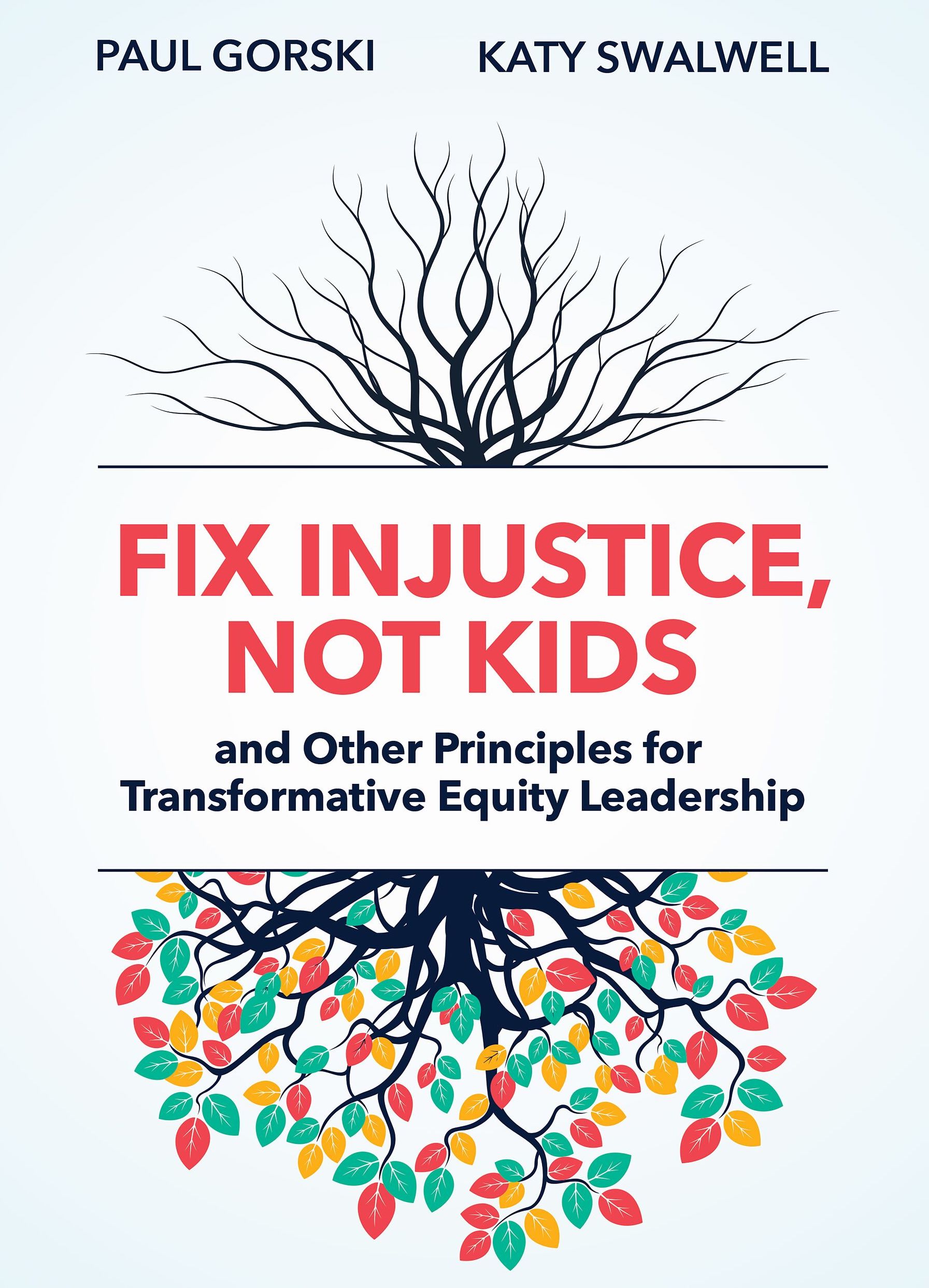
Fix Injustice, Not Kids and Otther Principles for Transformative Equity Leadership (ASCD, 2023), by Paul Gorski & Katy Swalwell, is the deepest dive yet into the equity literacy framework and its core principles. If you are attempting to lead equity efforts in a school a district, whether from positional leadership as a principal or equity director or from a more informal role, this book will provide you with critical shifts in perspective to make sure your equity efforts are as meaningful as possible. Key principles include (1) direct confrontation (we must grapple honestly with inequity rather than embracing tangential "diversity" strategies), (2) fix injustice not kids (we should never focus equity efforts on adjusting anything about people who are marginalized), (3) just access (the question is not just whether we're providing equitable access, but also whether the things to which we're providing access are, themselves, equitable), and more.
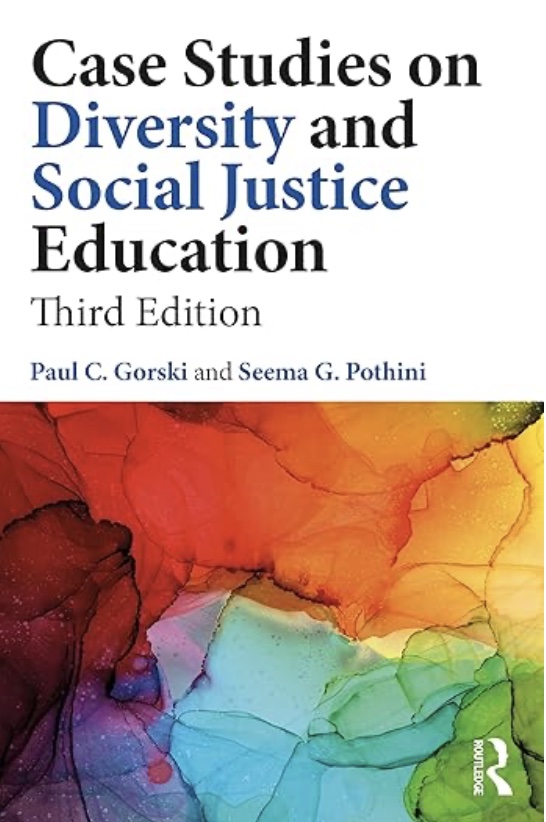
Case Studies on Diversity and Social Justice Education, 3rd edition (Routledge, 2023), by Paul Gorski and Seema Pothini, book offers pre- and in-service educators an opportunity to analyze and reflect upon a variety of realistic case studies related to educational equity and social justice. Each case, written in an engaging, narrative style, presents a complex but common classroom scenario in which an inequity or injustice is in play. These cases allow educators to practice the process of considering a range of contextual factors, checking their own biases, and making immediate- and longer-term decisions about how to create and sustain equitable learning environments for all students. The book begins with a seven-point process for examining case studies. Largely lacking from existing case study collections, this framework guides readers through the process of identifying, examining, reflecting on, and taking concrete steps to resolve challenges related to diversity and equity in schools.
Reaching and Teaching Students in Poverty: Strategies for Erasing the Opportunity Gap, 2nd edition (Teachers College Press, 2018), by Paul Gorski, equips educators with knowledge and practical strategies to bolster the learning and engagement of students in poverty. In a collegial and narrative tone and drawing on the equity literacy framework, the author draws from decades of research to deconstruct popular myths, misconceptions, and educational practices that undercut the achievement of students experiencing poverty before describing the challenges that they face. Most importantly, this book provides specific, evidence-based strategies for teaching youth experiencing poverty by creating equitable, bias-free learning environments. According to Gary Howard, author of We Can't Teach What We Don't Know, ''This is the 'poverty book' I've been waiting for. It provides powerful, clear-eyed analysis of why economic inequities exist and persist, and practical classroom-tested guidance for teachers and leaders who care to make a difference. Paul Gorski's voice is passionate, accessible, politically astute, and (I hope) impossible to ignore.''
 Voices for Diversity and Social Justice: A Literary Education Anthology (Rowman & Littlefield, 2015), by Julie Landsman, Rosanna Salcedo, and Paul C. Gorski (Eds.), is an unflinching exploration through poetry, prose, and art of the heart of our educational system--of the segregation, bias, and oppression that are part of the daily lives of so many students and educators. It is also a series of poetical insights into the fights for liberation and resistance at the heart of many of the same students' and teachers' lives. The contributors--youth, educators, activists, othersÑshare what it is like to face discrimination, challenge unjust policy, or subvert monotony by cultivating a vibrant, equitable, revolutionary school environment. This is not a prescriptive text, but instead a call to action. It is a call from many literary voices to create schools where social justice is at the core of education. Stunning in its revelations, Voices for Diversity and Social Justice is an anthology by educators and students unafraid to be passionate about what is missing, what is needed, and what is working in order to make that vision a reality. Voices for Diversity and Social Justice: A Literary Education Anthology (Rowman & Littlefield, 2015), by Julie Landsman, Rosanna Salcedo, and Paul C. Gorski (Eds.), is an unflinching exploration through poetry, prose, and art of the heart of our educational system--of the segregation, bias, and oppression that are part of the daily lives of so many students and educators. It is also a series of poetical insights into the fights for liberation and resistance at the heart of many of the same students' and teachers' lives. The contributors--youth, educators, activists, othersÑshare what it is like to face discrimination, challenge unjust policy, or subvert monotony by cultivating a vibrant, equitable, revolutionary school environment. This is not a prescriptive text, but instead a call to action. It is a call from many literary voices to create schools where social justice is at the core of education. Stunning in its revelations, Voices for Diversity and Social Justice is an anthology by educators and students unafraid to be passionate about what is missing, what is needed, and what is working in order to make that vision a reality.
 Talking Back and Looking Forward: An Educational Revolution in Poetry and Prose (Rowman & Littlefield, 2016), by Paul C. Gorski, Rosanna Salcedo, and Julie Landsman (Eds.) is a revolution in a book. As schools grow more and more vulnerable to the whims of profiteers and, as a result, become less and less a sacred public space of learning and justice, the voices of everyday educators and students are increasingly marginalized. This is the tyranny of neoliberal school reform: silence the people who know education, the people committed to equity and justice, and elevate the voices and desires of the privileged few whose knowledge of education is peripheral and profit-driven. Talking Back and Moving Forward: An Education Revolution in Poetry and Prose is a collective response to this tyranny, a collecting rallying cry for reclaiming our schools. It is a chorus of voices from teachers, educators, and educational justice advocates who refuse to be silencedÑwho are standing up and responding to the imposition of damaging school reform initiatives. Unconfined by the conventions of the traditional scholarly voice, the contributors use poetry, memoir, short stories, and photography, choosing the expressions that most effectively capture their experiences and their demands for educational and social justice. Talking Back and Looking Forward: An Educational Revolution in Poetry and Prose (Rowman & Littlefield, 2016), by Paul C. Gorski, Rosanna Salcedo, and Julie Landsman (Eds.) is a revolution in a book. As schools grow more and more vulnerable to the whims of profiteers and, as a result, become less and less a sacred public space of learning and justice, the voices of everyday educators and students are increasingly marginalized. This is the tyranny of neoliberal school reform: silence the people who know education, the people committed to equity and justice, and elevate the voices and desires of the privileged few whose knowledge of education is peripheral and profit-driven. Talking Back and Moving Forward: An Education Revolution in Poetry and Prose is a collective response to this tyranny, a collecting rallying cry for reclaiming our schools. It is a chorus of voices from teachers, educators, and educational justice advocates who refuse to be silencedÑwho are standing up and responding to the imposition of damaging school reform initiatives. Unconfined by the conventions of the traditional scholarly voice, the contributors use poetry, memoir, short stories, and photography, choosing the expressions that most effectively capture their experiences and their demands for educational and social justice.
Check out The Poverty and Education Reader (Stylus, 2013), edited by Paul C. Gorski and Julie Landsman. Through a rich mix of essays, memoir, and poetry, the contributors describe the schooling experiences of poor and working class students, highlighting the resiliency, creativity, and educational aspirations of low-income families. They showcase proven strategies that imaginative teachers and schools have adopted for closing the opportunity gap, demonstrating how they have succeeded by working in partnership with low-income families, and despite growing class sizes, the imposition of rote pedagogical models, and teach-to-the-test mandates. Teachers, students, parents, educational activists, and scholars repudiate the prevalent, but too rarely discussed, deficit views of students and families in poverty. Rather than focusing on how to "fix" poor and working class youth, they challenge us to acknowledge the ways these youth and their families are disenfranchised by educational policies and practices that deny them the opportunities enjoyed by their wealthier peers. Just as importantly, they offer effective school and classroom strategies to mitigate the effects of educational inequality on students in poverty.
Check out Cultivating Social Justice Teachers: How Teacher Educators Have Helped Students Overcome Cognitive Bottlenecks and Learn Critical Social Justice Concepts (Stylus, 2012), the new book edited by Paul C. Gorski, Kristien Zenkov, Nana Osei-Kofi, and Jeff Sapp. Each chapter describes how a veteran teacher educator came to find effective strategies for teaching a complex concept related to equity, diversity, and social justice. Chapters cover topics such as intersectionality, white privilege, essentialism, heteronormativity, Christian privilege, and the myth of meritocracy. The authors initiate a conversation – one largely absent in the social justice education literature and the discourse – about the common content- and pedagogy-related challenges that social justice educators face in their work, particularly for those doing this work in relative or literal isolation, where collegial understanding cannot be found down the hall or around the corner. In doing so they hope not only to help individual teachers in their practice, but also strengthen social justice teacher education more systemically. According to Kevin Kumashiro, "This book is one that no teacher educator—or any educator—can or should do without." Read the Introduction and Table of Contents.
Check out Decolonizing "Multicultural" Counseling through Social Justice (Spring 2015), the new book edited by Rachael Goodman and Paul C. Gorski. In this groundbreaking book, counseling and psychology scholars and practitioners examine the "multicultural" paradox through a social justice lens by questioning and challenging the infrastructure of dominance in society, as well as by challenging practitioners, scholars, and activists to rethink our commitments. The authors analyze the ways well-meaning clinicians might marginalize clients and contribute to structural inequities despite multicultural or cross-cultural training, and offer new frameworks and skills to replace the essentializing and stereotyping practices that are widespread in the field. By addressing the power imbalances embedded in key areas of multicultural theory and practice, contributors present innovative methods for revising research paradigms, professional education, and hands-on practice to reflect a commitment to equity and social justice. Together, the chapters in this book model transformative practice in the clinic, the schools, the community, and the discipline.
Short Essays and Quick Reads
Moving from Equity Awareness to Action (2023): in a themed issue of Educational Leadership
Stop Punishing Poverty in Schools (2023): in a themed issue of Educational Leadership on poverty
Trading Baby Steps for Big Equity Leaps (2022): in a themed issue of Educational Leadership on equity
How Trauma-Informed Are We, Really? (2020): in a themed issue of Educational Leadership on trauma-sensitive schools
Avoiding Racial Equity Detours (2019): in a themed issue of Educational Leadership on race and racism
Reexamining Beliefs about Students in Poverty (2016): a feature article for School Administrator magazine
Equity Literacy: More than Celebrating Diversity (2016): a feature article for Diversity in Education magazine
Equity Literacy for All (2015): an article by Paul C. Gorski and Katy Swalwell in Educational Leadership magazine
Poverty, Class, and the Cultivation of Economically Just Educational Policy (2014): an article by Paul C. Gorski for Research Intelligence, a publication of the British Educational Research Association
Case Studies on Diversity & Social Justice Education (2014): an excerpt from the book by Paul C. Gorski and Seema Pothini, published in Teaching Tolerance magazine
Imagining Equity Literacy (or, The Insufficiency of Cultural Proficiency) (2014): a guest blog for the Teaching Tolerance web site
Building a Pedagogy of Engagement for Students in Poverty (2013): published in Phi Delta Kappan, a brief synthesis of instructional and relational strategies.
Five Stereotypes About Poor Families and Education (2013): an excerpt of my book, Reaching and Teaching Students in Poverty, published by the Washington Post.
Social Justice: Not Just Another Term for "Diversity": short blog post on the relationship between diversity and social justice efforts in higher education contexts, written for the ACPA Commission for Social Justice Educators
Complicating White Privilege: Race, Class, and the Nature of the Knapsack: my brief (and illustrated!) essay published by Counterpunch about how I came to understand the limitations of today's conversations about "white privilege"(see the version pubished by Counter punch here)
Introduction to Assault on Kids: How Hyper-Accountability, Corporatization, Deficit Ideologies, and Ruby Payne Are Destroying Our Schools (2011, Peter Lang Publishers)
by Roberta Ahlquist, Paul C. Gorski, and Theresa Montaño
Taco Night (revised 2011)
Short humor piece on the dangers of reducing educational equity to "celebrating the joys of diversity."
Equity and Social Justice from the Inside-Out: Ten Commitments of a Multicultural Educator (2011): an entry for the Equity Matters blog
Education Equity and the Trouble with Pragmatic Decision Making (2011): an essay written for the LeadScape blog
When It Was Poster Board: Computer Technologies and School Disadvantage (2011): a blog entry for Classism Exposed
A Wealth of Whammies for Youth in Poverty (2010): an article for the blog, Classism Exposed
Becoming Joey (2009): a poem about dual identity, race, and schooling (a version of this poem was published in the book, White Teachers/Diverse Classrooms)
Critical Ties: The Animal Rights Awakening of a Social Justice Educator (2009): a short reflective article about the link between social justice and animal rights
The Myth of the Culture of Poverty (2008, as published in Educational Leadership)
The Evolution of a Pro-Feminist (2008; a version of this short reflective essay will be published in the 2nd edition of the book, Readings for Diversity and Social Justice)
The Question of Class (2007; as published by Teaching Tolerance)
Countering Standardization (2007, by Julie Landsman and Paul C. Gorski, as published in Educational Leadership)
Defining Multicultural Education (2002; updated 2010)
Narrative of Whiteness and Multicultural Education (2000, as published in the Electronic Magazine of Multicultural Education)
A Brief History of Multicultural Education (1999)
Research and Journal Articles
Personal Deficiency, Racism, or Culture Clash? Teacher Candidates' Beliefs about Why Racial Discipline Disparities Exist (2025) by Madalina Tans and Paul C. Gorski in Teaching and Teacher Education
Adult SEL and the Racial Equity Imperative: Three Key Commitments (2025) by Diana Huizar, Zoey Phillips, & Paul C. Gorski in Intercultural Education
Supporting Critical Multicultural Educator Educators: Transformative Teaching, Social Justice, and Perceptions of Institutional Support (2020) by Paul C. Gorski and Gillian Parekh, advance online version of article to be published in Intercultural Education
Striving for Critical Reflection in Multicultural and Social Justice Teacher Education: Introducing a Typology of Reflection Approaches (2019) by Paul C. Gorski and Kelly Dalton, advance online version of article to be published in the Journal of Teacher Education
Racial Battle Fatigue and Activist Burnout in Racial Justice Activists of Color at Predominately White Colleges and Universities (2018) by Paul C. Gorski, published in Race, Ethnicity, and Education
Fighting Racism, Battling Burnout: Causes of Activist Burnout in US Racial Justice Activists (2018) by Paul C. Gorski, published in Ethnic and Racial Studies
Rethinking the Role of "Culture" in Educational Equity: From Cultural Competence to Equity Literacy (2016) by Paul C. Gorski, published in the Multicultural Perspectives
Poverty and the Ideological Imperative: A Call to Unhook from Deficit and Grit Ideology and to Strive for Structural Ideology in Teacher Education (2016) by Paul C. Gorski, published in the Journal of Education for Teaching
The Gendered and Heterosexist Evolution of the Teacher Exemplar in the United States: Equity Implications for LGBTQ and Gender Nonconforming Teachers (2016) by Michele Kahn and Paul C. Gorski, published in the International Journal of Multicultural Education
Burnout in Social Justice and Human Rights Activists: Symptoms, Causes, and Implications (2015) by Cher Chen and Paul C. Gorski, published in the Journal Human Rights Practice
"Frayed All Over": The Causes and Consequences of Activist Burnout Among Social Justice Education Activists (2015) by Paul C. Gorski, published in the Educational Studies
Relieving Burnout and the "Martyr Syndrome" Among Social Justice Education Activists: The Implications and Effects of Mindfulness (2015) by Paul C. Gorski and Cher Chen, published in the Urban Review
Consumerism as Racial and Economic Injustice: The Macroaggressions that Make Me, and Maybe You, a Hypocrite (2014): from the journal, Understanding and Dismantling Privilege
Equity and Social Justice from the Inside-Out: Ten Commitments for Intercultural Educators (2013), published in the book Mapping the Broad Field of Multicultural and Intercultural Education Worldwide
An Examination of the (In)Visibility of Sexual Orientation, Heterosexism, Homophobia, and Other LGBTQ Concerns in U.S. Multicultural Teacher Education Coursework (2013) by Paul C. Gorski, Shannon N. Davis, and Abigail Reiter, published in the Journal of LGBT Youth
Teaching against Essentialism and the 'Culture of Poverty' (2012): appears in the book, Cultivating Social Justice Teachers [Stylus, 2012])
Perceiving the Problem of Poverty and Schooling: Deconstructing the Class Stereotypes that Mis-Shape Education Practice and Policy (2012): published in the journal, Equity & Excellence in Education
Instructional, Institutional, and Sociopolitical Challenges of Teaching Multicultural Teacher Education Courses (2012): published in the journal, The Teacher Educator
Self-Efficacy and Multicultural Teacher Education in the United States: The Factors that Influence Who Feels Qualified to Be a Multicultural Teacher Educator (2012) by Paul C. Gorski, Shannon N. Davis, and Abigail Reiter, published in the journal, Multicultural Perspectives
Is There a Hierarchy of Oppression in Multicultural Teacher Education? (2011): published in the journal, Action in Teacher Education
Unlearning Deficit Ideology and the Scornful Gaze: Thoughts on Authenticating the Class Discourse in Education (2011): appears in the book, Assault on Kids: How Hyper-Accountability, Corporatization, Deficit Ideologies, and Ruby Payne Are Destroying Our Schools [Peter Lang, 2011])
The Scholarship Informing the Practice: Multicultural Teacher Education Philosophy and Practice in the U.S. (2010): an analysis of data from the Social Justice and Multicultural Teacher Educators Resource Survey, published by the International Journal of Multicultural Education
Intercultural Education as Social Justice (2009, as published in Intercultural Education): this is an introduction to a special issue in which I argue that the root of interculturalism must be equity
Cognitive Dissonance: A Critical Tool of Social Justice Teaching (published in Multiculticultural Education, 2009)
What We're Teaching Teachers: An Examination of Multicultural Teacher Education Coursework (Journal of Teaching and Teacher Education, 2009)
Peddling Poverty for Profit: Elements of Oppression in Ruby Payne's Framework (2009, as published in Equity and Excellence in Education)
Savage Unrealities: Racism and Classism Abound in Ruby Payne's Framework (2008, as published in Rethinking Schools)
Good Intentions Are Not Enough: A Decolonizing Intercultural Education (Intercultural Education, 2008)
Insisting on Digital Equity: Reframing the Dominant Discourse on Multicultural Education and Technology (Urban Education, 2007)
Savage Unrealities: Uncovering Classism in Ruby Payne's Framework (2005)
Savage Unrealities: Abridged Version (2005; a shortened version of the above essay)
Keynotes and Interviews
IDRA's interview of me on "Opportunity Matters: The Path to Equity Literacy" (2015)
Principal Center's interview of me on my book, Reaching and Teaching Students in Poverty (2015)
Interview for Intersections Radio on my work related to the intersections of social justice, environmental justice, and animal rights (2014)
Celebrating Diversity Is Not Enough: Finding Authentic Pathways to Equity (2010), my opening keynote for the 2010 Leadership for Equity and Excellence Forum, hosted by the Equity Alliance at Arizona State University (forward the video to about the 12 minute, 30 second mark)
The Institute for Humane Education's interview of Jennifer Hickman and Paul C. Gorski (September 2010) about the birth of EdChange and the intersections between multicultural humane education.
Read an interview published in Connections, the journal of the National School Reform Faculty, in fall 2007.
Older Books
Check out Poverty, Class, and Schooling: Global Perspectives on Economic Justice and International Advances in Education (Information Age Publishing, 2015), the new book edited by Elinor Brown, Paul C. Gorski, and Gabriella Lazaridis. Chapters in this book are drawn from a wide range of countries including Australia, Brazil, Canada, China, Finland, Georgia, Haiti, India, Italy, Kyrgyzstan, Portugal, Slovenia, Tanzania, Ukraine, and The United States. Each addresses issues of educational inequity, economic injustice, class bias and the links between education, poverty and social status. The individual chapters provide examples of theory, research, and practice that collectively present a lively, informative, cross-perspective, international conversation highlighting the significant gross economic and social injustices that abound in a wide variety of educational contexts around the world while spotlighting important, inspirational, and innovative remedies. Taken together, the chapters advance our understanding of best practices in the education of economically disadvantaged and socially marginalized populations while collectively rejecting institutional policies and traditional practices that reinforce the roots of economic and social discrimination.
Check out Big Lies of School Reform: Finding Better Solutions for the Future of Public Education (Routledge, 2014), by Paul C. Gorski and Kristien Zenkov (Eds). In this book some of the most respected minds in educational equity provide a critical interruption to the ongoing policy conversations taking place around public education in the United States. By analyzing the discourse employed by politicians, lobbyists, think tanks, and special interest groups, the authors uncover the hidden assumptions that often underlie popular statements about school reform, and demonstrate how misinformation or half-truths have been used to reshape public education in ways that serve the interests of private enterprise. Contributors including Deborah Meier, Jeannie Oakes, Gloria Ladson-Billings, Wayne Au, Katy Swalwell, Anthony Cody, and Jim Cummins explain how reform movements affect teachers and administrators, and how widely-accepted mistruths can hinder genuine efforts to keep public education equitable, effective, and above all, truly public. Topics include common core standards, tracking, alternative paths to licensure, and the disempowerment of teachers’ unions.
 Check out Assault on Kids: How Hyper-Accountability, Corporatization, Deficit Ideologies, and Ruby Payne Are Destroying Our Schools, a book edited by Roberta Ahlquist, Paul C. Gorski, and Theresa Montaño (Peter Lang, 2011). Hyper-accountability, corporatization, deficit ideology, and Ruby Payne's preparation of teachers to comply with these and other atrocities are not merely markers of philosophical shifts in education. They are manifestations of a neoliberal remaking of public schooling into a private and corporate enterprise. Collectively, these trends are experienced not just as an imposition, but as an assault on quality pedagogy; an assault on democratic ideals of equity and social justice; and an assault on kids compelled to participate simply because they are public school students. This edited collection is a response by critically-minded educators, activists, and scholars - both a reaction to and a call to action against these vilifications. It is critical reading for students, professors, administrators, and policy makers involved in public education. In this book, teachers, activists, and scholars describe this assault and how to counteract it. Check out Assault on Kids: How Hyper-Accountability, Corporatization, Deficit Ideologies, and Ruby Payne Are Destroying Our Schools, a book edited by Roberta Ahlquist, Paul C. Gorski, and Theresa Montaño (Peter Lang, 2011). Hyper-accountability, corporatization, deficit ideology, and Ruby Payne's preparation of teachers to comply with these and other atrocities are not merely markers of philosophical shifts in education. They are manifestations of a neoliberal remaking of public schooling into a private and corporate enterprise. Collectively, these trends are experienced not just as an imposition, but as an assault on quality pedagogy; an assault on democratic ideals of equity and social justice; and an assault on kids compelled to participate simply because they are public school students. This edited collection is a response by critically-minded educators, activists, and scholars - both a reaction to and a call to action against these vilifications. It is critical reading for students, professors, administrators, and policy makers involved in public education. In this book, teachers, activists, and scholars describe this assault and how to counteract it.
 Growing Up White: A Veteran Teacher Reflects on Racism Growing Up White: A Veteran Teacher Reflects on Racism
by Julie Landsman
Rowman and Littlefield, 2008
Growing Up White is for everyone who wants to know more about our schools, our community, our country, and ourselves. Julie Landsman takes the reader on an inventory of her life, pulling from events and scenes, a set of lessons learned. She discloses honestly and unflinchingly the privileges she has experienced as a white person and connects those to her presence in city classrooms where she taught for over 25 years. As a teacher Julie made mistakes, learned from them, made more and concludes that understanding race in America is an ongoing process. Her book is rich with suggestions for working in our schools today, where we find a primarily white teaching force and an expanding population of students of color. She believes that these students make our schools rich and exciting places in which to work. Landsman also believes that white teachers can reach their students in deep and positive ways. Because she invites you to go along with her in revealing the basis of her upbringing and her choices, the story itself is engaging. Readers arrive at the final chapters with an appreciation not only for the complexity of our history as individuals around race, gender and class but with real hope in education as a way to create a place where all children get a fair chance at success.
 White Teachers / Diverse Classrooms: A Guide to Building Inclusive Schools, Promoting High Expectations, and Eliminating Racism White Teachers / Diverse Classrooms: A Guide to Building Inclusive Schools, Promoting High Expectations, and Eliminating Racism
by Julie Landsman & Chance W. Lewis (Eds.)
Stylus, 2006
This book, co-edited by EdChange's Julie Landsman, encourages reflection and self-examination, calls for understanding how students can achieve and expecting the most from them. It demonstrates what’s involved in recognizing often-unconscious biases, confronting institutional racism where it occurs, surmounting stereotyping, adopting culturally relevant teaching, connecting with parents and the community, and integrating diversity in all activities. White Teachers / Diverse Classrooms is replete with examples of practice and telling insights that will engage teachers in practice or in service. It should have a place in every classroom in colleges of education. Its empowering message applies not just to teachers of Black students, but illuminates teaching in every racially diverse setting. This edited volume contains chapters by EdChange team members Robert Simmons and Paul C. Gorski and is co-edited by Julie Landsman, a regular collaborator with EdChange.
 Multicultural Education and the Internet: Intersections and Integrations (2nd edition) Multicultural Education and the Internet: Intersections and Integrations (2nd edition)
by Paul C. Gorski
McGraw-Hill, 2004
In this book, Paul C. Gorski employs a critical multicultural education perspective for examining the potentials and dangers of the increasing use of computers and the Internet in education. Roughly half the book is dedicated to a deep exploration of ways in which these technologies, when used outside critical reflective practice can, and are, contributing to the inequities already present in our classrooms and schools. A new second chapter frames the digital divide in this context. The other half of the book describes ways in which these technologies can be used in pedagogically progressive ways consistent with multicultural education. The end of the book contains a guide to Web sites contributive to multicultural education theory and practice.
 A White Teacher Talks about Race A White Teacher Talks about Race
by Julie Landsman
Rowman and Littlefield, 2000
Experienced teacher and Minneapolis writer Landsman here describes a typical day in an inner-city, alternative high school program. She discusses the daily trials and triumphs of her students, 75 percent or more of whom are not of European descent and many with family difficulties, children of their own to support, and daily confrontations with violence and racism. Through her experiences, Landsman portrays some of the practices that work with "nontraditional" students, such as having them write from different perspectives and offering more inclusive lessons about history, and she points out the flaws of current "one size fits all" approaches to education. This readable book conveys its message simply and powerfully.
 Multicultural Resource Series: Professional Development for Educators Multicultural Resource Series: Professional Development for Educators
by Paul C. Gorski and Gene-Tey Shin
National Education Association, 1999
Real multicultural education is ongoing, inclusive teaching that validates the lives and experiences of all children. The Multicultural Resource Series is a practical guide for educators committed to quality learning for all students. The first book in the series, Professional Development Guide for Educators, features personal essays by educators who describe how multicultural education has transformed their teaching. The guide also serves as a comprehensive source for multicultural organizations, publications, videos, and Web sites. Resources for A Multicultural Classroom, the second book, is an annotated resource guide to help teachers choose the best print, video, and electronic resources for students.
Home | Who We Are | Our Philosophy | Consulting & Workshops | Projects
Publications | Free Handouts | Links | Suscribe to Our Newsletter | Shop | Contact Us
EdChange
Becoming a threat to inequity in schools and beyond through Equity Literacy
Contact Us
|